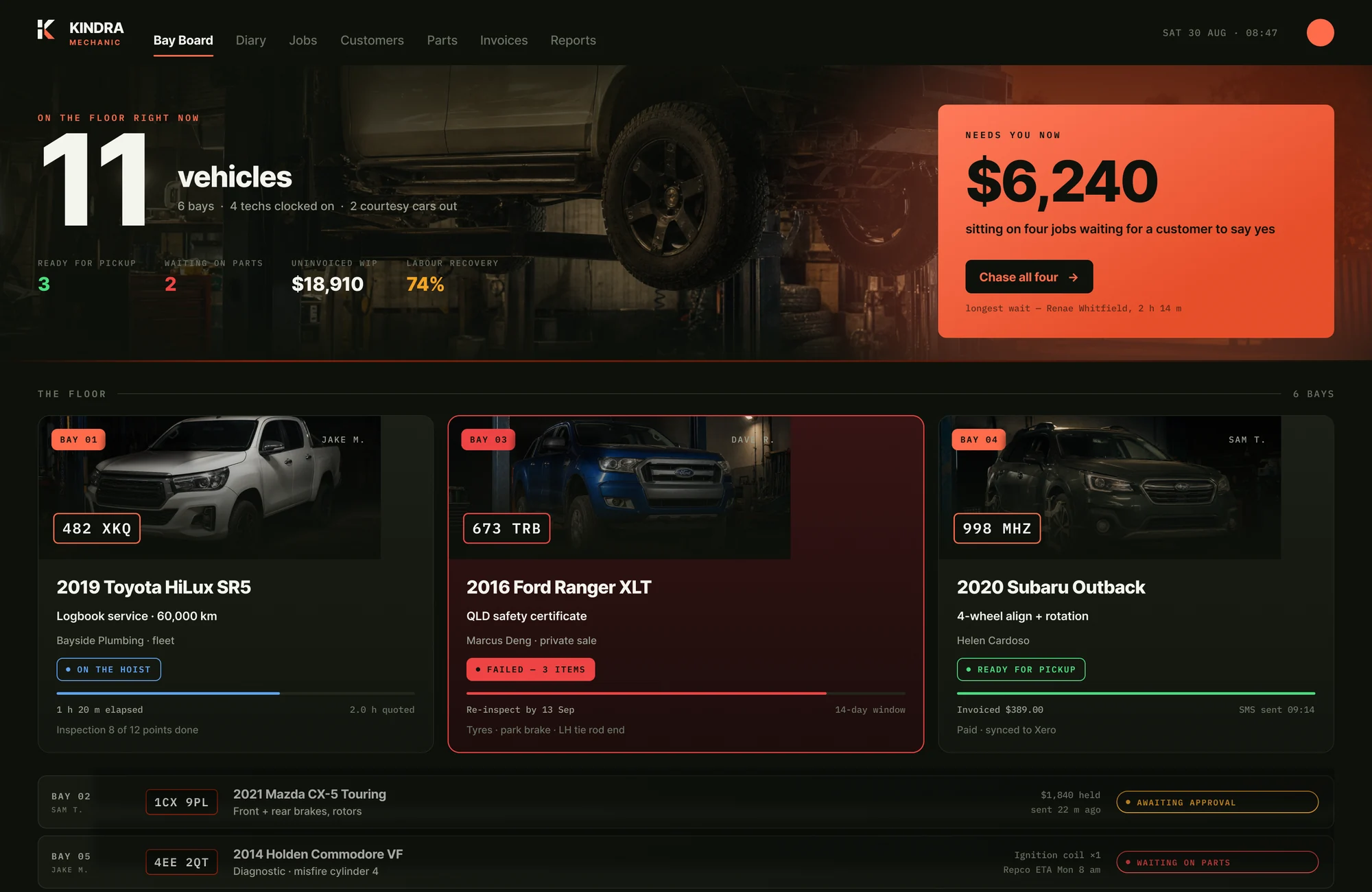
Bookings, bay board, job cards, parts, invoicing and follow-up in one place — not a whiteboard, a diary, a paper card and Xero.
And when your tech finds something, the customer gets a photo and a measurement, and approves it line by line from their phone.
Rego lookup · QLD safety certificates · Xero sync · Courtesy cars


The whiteboard says what's in each bay, but not what's waiting on a part. The diary says who's booked Tuesday, but not that Tuesday's already over-committed. The job card is in the car, so the front desk can't answer a phone call about it. The parts order is a text message. And none of it becomes an invoice without someone typing it all again at 6pm.
So you carry the shop in your head. Which works — right up until you take a day off, or someone quits, or you try to sell the place.
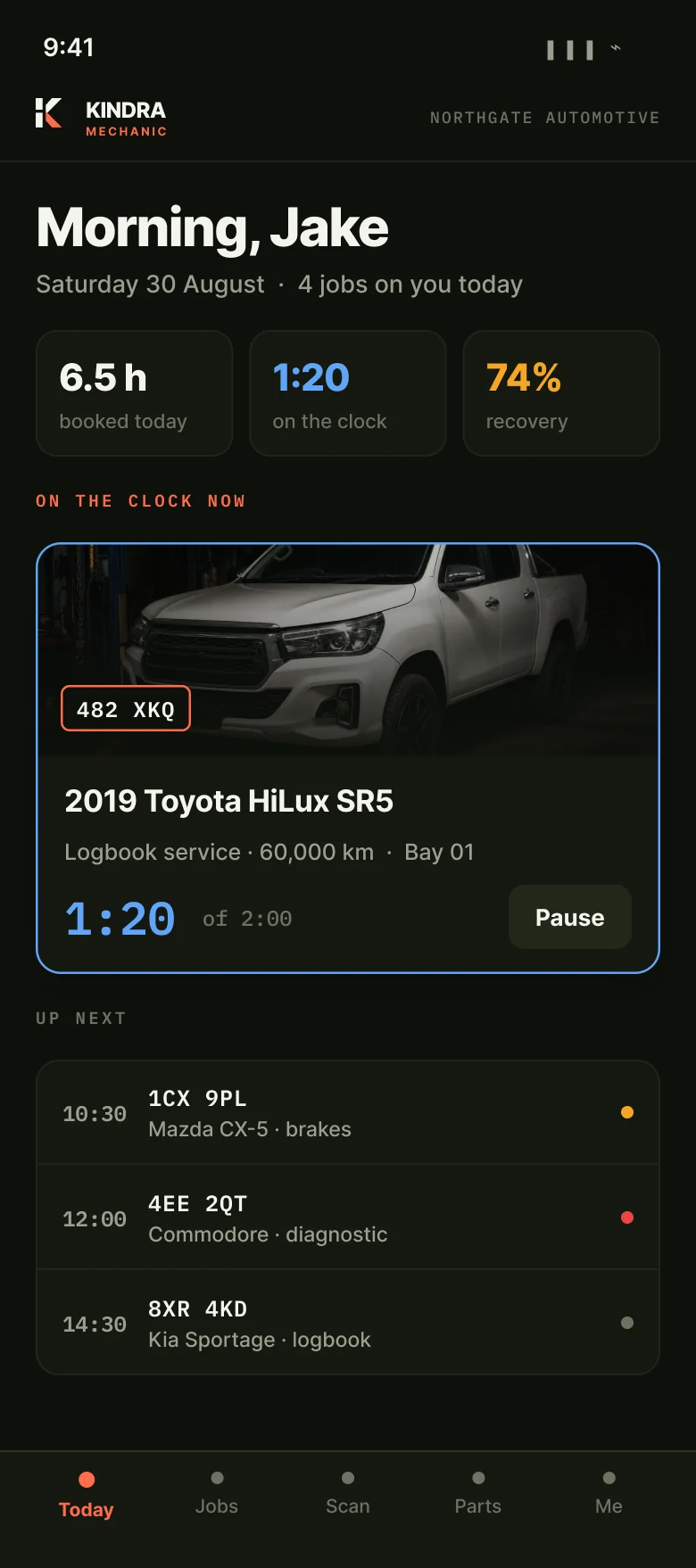
Not a bolt-on that sits beside what you already run. Every part of it feeds the next — and every screen below is the real thing. Click any of them to open it full size.
Fourteen on the desk, seven in the tech's hand, six on the customer's phone. Nothing here is a placeholder.
The tech grades on the phone — twelve points, three buttons. Anything flagged gets a photo, a measurement and the threshold. The customer gets it as a text, in plain English, and approves it line by line.
Go on — tap through it. That's the customer's screen, and it's the whole argument in ten seconds.
Partial acceptance is revenue that currently walks out the door. You're not selling harder — the photo and the measurement do the convincing, and the declined-work register makes sure it gets asked a second time.
Fourteen on the desk, seven in the tech's hand, six on the customer's phone. Pick one from the list — click it to open it full size.
Most owners have never seen the gap between hours clocked and hours billed. This shows the gap, splits it by cause — waiting on parts, waiting on approval, comebacks, tidy-up — and puts a dollar figure on each.
The biggest line is usually parts timing. That's a scheduling fix, not a hiring one.
One screen shows what's in every bay, what's blocked and why. The front desk can answer a job question without walking out to the car. You can take a Friday off.
Job card → invoice → Xero, once. That's the hour at 6pm you currently spend re-entering work you already did.
Customers watch the job move: booked → checked in → inspection done → work under way → ready. The front desk stops fielding the same call six times.
QLD safety certificates run on a hard 14-day clock. Miss it and the customer pays for a full re-test and blames you. Texts go out at day 7 and day 11, automatically.
Check-in walkaround with pins on a vehicle diagram, photos against each one, and the customer signs on the phone. "That wasn't there before" stops being a conversation.
A shop that runs out of one system, with its history recorded, is a business you can hand over, hire into, or sell. A shop that runs out of your head is a job with staff.
A plate is how you find a vehicle, not a VIN buried three screens deep.
AIS numbers, the register, and the 14-day re-inspection clock.
On the invoice, where they belong.
Not QuickBooks-first with an Australian setting bolted on.
Logbook intervals and warranty stamps, handled properly.
Allocated at booking. Fleet accounts with their own labour rate and parts discount.
Not a demo reel. We look at how the work actually moves through your bays, where it stalls, and what happens to the jobs your techs find but nobody follows up.